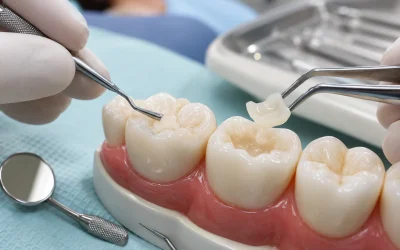
When you’re facing tooth damage or decay, understanding root canal vs filling is essential. Both treatments aim to preserve your tooth, but they solve different problems.
Below, we explain how dentists decide between them, what each procedure involves, how long results typically last, and how to care for your tooth afterward—so you can make a confident, informed choice.
The Decision Framework: What Dentists Evaluate
Before recommending root canal vs filling, your dentist considers four factors:
- Depth of decay and pulp status
- If decay is limited to enamel/dentin and the pulp is healthy, a filling is usually appropriate.
- If bacteria have reached or inflamed the pulp (irreversible pulpitis) or caused infection/necrosis, a root canal is indicated.
- Symptoms
- Short, mild sensitivity to cold/sweet often points to a filling.
- Spontaneous pain, lingering hot/cold sensitivity, pain on chewing, or swelling suggest a root canal.
- Tooth structure remaining
- Small–moderate cavities can be restored with a filling.
- Extensive loss of structure may require a root canal followed by a crown for reinforcement.
- Diagnostics
- X-rays, percussion, and vitality tests help confirm whether the pulp is healthy (favoring a filling) or compromised (favoring a root canal).
Dental Fillings: Indications, Materials, and Steps
When a Filling Is the Right Choice
- Early to moderate cavities or minor fractures that don’t involve the pulp
- Replacement of old, failing fillings
- Small chips that can be bonded
Common Materials
- Composite resin (tooth-colored, versatile)
- Glass ionomer (useful near the gumline; fluoride release)
- Porcelain inlays/onlays (lab-made, for larger defects)
- Amalgam (durable, less used in esthetic zones)
Procedure Overview (Often One Visit)
- Numbing (if needed) and isolation
- Removal of decay, shaping of the cavity
- Bonding/placement of material in layers
- Shaping, bite check, polishing
Pros: Minimally invasive, cost-effective, quick recovery.
Limitations: If decay is deep or the tooth is cracked into the pulp, a filling alone will not resolve pain/infection.
Root Canal Therapy: Indications, Workflow, and Restoration
When a Root Canal Is the Better Option
- Deep decay reaching the pulp
- Irreversible pulpitis (lingering pain to hot/cold)
- Pulp necrosis with/without abscess
- Trauma causing pulp damage
What the Procedure Involves (One or More Visits)
- Anesthesia and isolation
- Access to the canal space
- Cleaning and shaping of canals, irrigation/disinfection
- Obturation (filling canals with a biocompatible material)
- Sealing the access and planning a definitive restoration
Don’t Skip the Final Restoration
After a root canal on a posterior tooth, a crown is commonly recommended to prevent fractures and restore function.
Pros: Removes infection/inflammation while preserving your natural tooth and bite.
Limitations: More complex than a filling; requires excellent sealing and a durable final restoration.
Root Canal vs Filling: Side-by-Side Comparison
- Primary goal
- Filling: Restore lost tooth structure from decay/wear.
- Root canal: Eliminate diseased pulp and seal the tooth from within.
- Complexity & time
- Filling: Simple; typically one short visit.
- Root canal: Longer appointment(s) + follow-up crown in many cases.
- Symptoms addressed
- Filling: Mild sensitivity, localized decay.
- Root canal: Spontaneous pain, lingering heat/cold, pain on biting, swelling.
- Longevity factors
- Filling: Lasts longer with good hygiene, balanced bite, smaller size.
- Root canal: Longevity depends on canal disinfection quality and the final crown/seal.
- Cost considerations
- Filling: Generally lower upfront cost.
- Root canal: Higher due to procedure complexity and the likely need for a crown—but it preserves your natural tooth, often avoiding extraction and replacement costs later.
Special Clinical Scenarios
- Very deep cavity but no lingering pain: Your dentist may consider a protective liner, indirect pulp cap, or onlay; close monitoring is essential.
- Cracked tooth, heavy bite/clenching: Even if the pulp is healthy now, extensive cracks may push the decision toward root canal plus full-coverage crown for long-term stability.
- Large failing restoration: If recurrent decay is extensive or symptoms suggest pulp involvement, root canal vs filling is reassessed with new diagnostics.
Recovery and Aftercare
After a Filling
- Temporary temperature sensitivity is common and usually fades in days.
- If the bite feels “high,” a minor adjustment resolves it quickly.
- Maintain daily hygiene; avoid very hard foods on large new restorations for 24–48 hours.
After a Root Canal
- Mild soreness when chewing can occur for a few days; OTC pain control typically helps.
- Avoid chewing hard foods on the treated tooth until the permanent crown/onlay is placed.
- Keep follow-up appointments—sealing the tooth properly is key to longevity.
Prevention That Reduces the Need for Either Treatment
- Daily hygiene: Fluoride toothpaste twice a day + interdental cleaning
- Diet: Limit frequent sugar/acid exposures; rinse after snacks
- Regular checkups: Early detection means simpler, smaller fillings instead of emergency root canals
- Nightguard if you clench/brux—protects teeth and restorations
The Smiles of Boca Approach
Still weighing root canal vs filling? At Smiles of Boca in Boca Raton, we combine detailed diagnostics (X-rays, vitality tests, bite analysis) with conservative, patient-first decisions. Our goal is to relieve symptoms, protect your natural tooth whenever possible, and choose the treatment that gives you the best long-term outcome.
Ready for clarity and a personalized plan? Book a visit—our team will walk you through root canal vs filling, explain your options in plain language, and restore your smile with precision and care.